
Battery storage
Home battery guide: the arithmetic that decides
A home battery earns the spread between your electricity price and your export rate, and it costs a fixed amount per stored kilowatt hour. Whether it is worth it is one honest comparison, worked here with European reference values.
How we verify every numberLast verified 4 August 2026
Key takeaways
- A battery pays when storing a kilowatt hour costs less than your grid price minus your export rate. That single comparison decides the purchase.
- At European reference values, storing costs about 9 to 28 cents per kWh depending on installed price and utilisation, against a reference spread of about 21 cents.
- The mid-range reference case pays back in about 14.6 years against a 15-year life: roughly break-even, tipped either way by your national spread.
- Most grid-tied systems give no power in a blackout; backup needs island-capable hardware and a dedicated circuit, specified explicitly in the quote.
- Size to overnight consumption and winter surplus, not to the biggest unit on offer: idle capacity ages without earning.
A home battery is worth it when storing a kilowatt hour costs less than the money you gain by shifting it: the spread between what you pay the grid and what the grid pays you. That is the entire economic question; everything else in a battery decision is detail feeding those two numbers.
This guide works that arithmetic with labelled European reference values, shows when batteries do not pay, sorts the honest non-financial reasons from the imagined ones, and ends with sizing. It assumes you have or plan a PV system; a battery without solar, trading on hourly tariffs alone, is a different calculation.
The two numbers: cost per stored kWh, and the spread
What a stored kilowatt hour costs
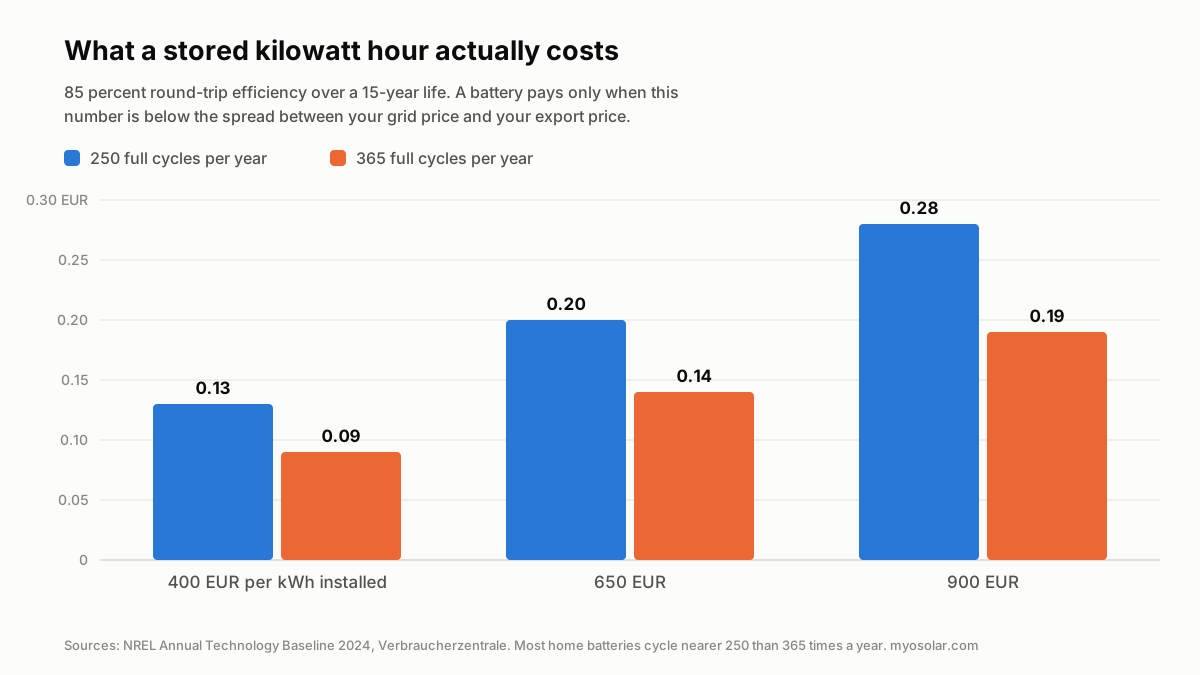
A battery's price buys a finite amount of shifting. Spread the installed cost over every kilowatt hour the battery will deliver in its life and you get the real product you are buying: cost per stored kWh, which is the installed cost per kWh of capacity divided by the lifetime number of full charge cycles, corrected for round-trip losses. As a European reference, installed home battery systems cost about 400 to 900 euros per kWh of capacity. Basis: consumer-authority price observations for the German market, Europe's largest, widened at the top to cover higher-cost markets. For the physics, the US National Renewable Energy Laboratory uses 85 percent as a representative round-trip efficiency for residential batteries and a 15-year life in its 2024 technology baseline.
Cycles are where honest and optimistic calculations part ways. A battery cycled fully once a day for 15 years performs about 5,500 full cycles. Real household batteries do less: in winter there is often no surplus to store, and in high summer the battery is full before noon while the evening is short. A realistic European pattern is closer to 250 full-cycle equivalents per year, about 3,750 over 15 years. Basis: derived arithmetic on the NREL life assumption; the cycle counts are labelled scenarios, and your utilisation depends on sizing and climate.
At 250 full cycles per year
- 400 EUR (low end of the reference range)0.13 EUR
- 650 EUR (mid range)0.20 EUR
- 900 EUR (high end)0.28 EUR
Show the numbersHide the numbers
| Installed cost per kWh of capacity | At 250 full cycles per year | At 365 full cycles per year |
|---|---|---|
| 400 EUR (low end of the reference range) | 0.13 EUR | 0.09 EUR |
| 650 EUR (mid range) | 0.20 EUR | 0.14 EUR |
| 900 EUR (high end) | 0.28 EUR | 0.19 EUR |
Basis: installed cost range as above, 85 percent round-trip efficiency and 15-year life per NREL, cycle counts as labelled scenarios; calendar ageing means a barely used battery still ages. The consequence: a cheap battery cycled hard stores for under 10 cents per kWh, an expensive one cycled gently costs nearly 30. Same product category, three-fold difference, decided mostly by how you size and use it.
What a stored kilowatt hour earns
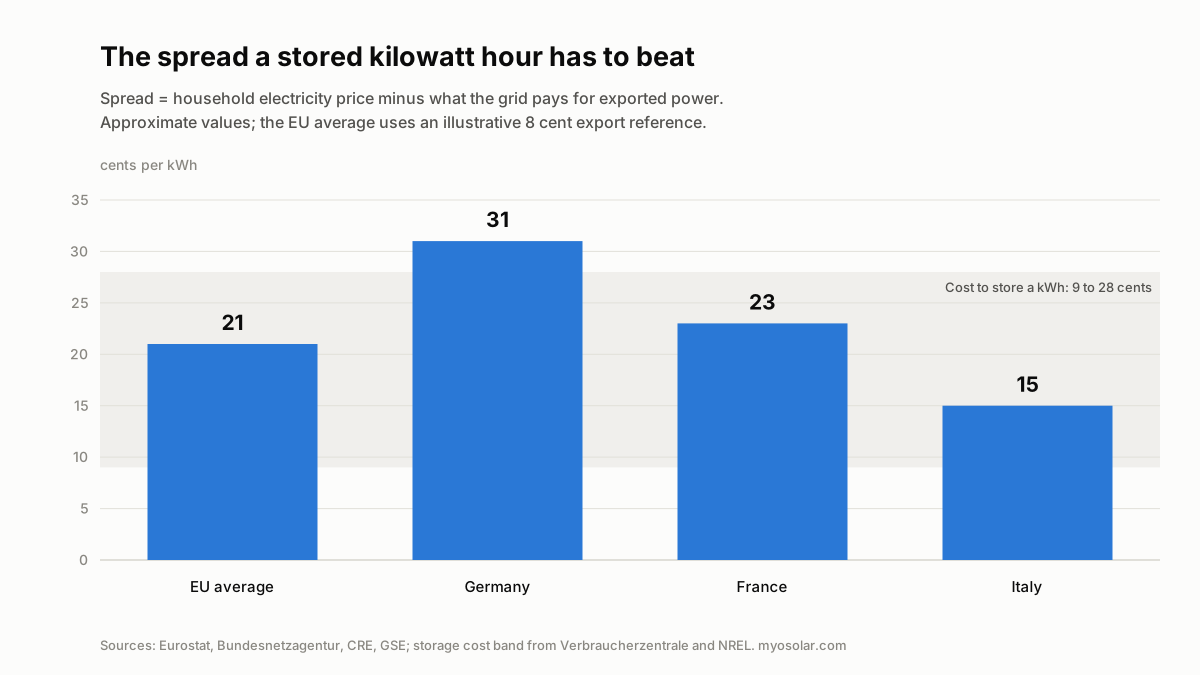
Each stored kilowatt hour replaces a grid purchase after sunset, but it also cancels the export payment that energy would have earned at noon. The gain is the spread between the two. As a European reference: the EU average household electricity price was 0.2896 euros per kWh in the second half of 2025 per Eurostat, and myosolar uses 8 cents as an illustrative European export reference, giving a spread of about 21 cents. National reality varies widely. In Germany the spread is currently about 31 cents: a 0.3869 euro price per Eurostat against the statutory 7.7 cent surplus tariff. In France it is about 23 cents against the 1.1 cent surplus tariff for new applications. In Italy it is closer to 15 cents, because the dedicated withdrawal scheme paid about 12.8 cents on average in early 2026. Check your national rules; the export side moves with policy. The consequence: the higher your electricity price and the lower your export pay, the better storage looks. A near-zero export regime is, perversely, a strong argument for a battery.
A worked European reference example
- Battery: 8 kWh at 650 EUR per kWh installed, total 5,200 EUR, the mid range of the European reference.
- Utilisation: 250 full-cycle equivalents per year, so 2,000 kWh sent into storage annually.
- Round-trip efficiency 85 percent per NREL: 1,700 kWh delivered back per year.
- Value per shifted kWh: the 21 cent European reference spread.
Annual gain: 1,700 kWh at 0.21 EUR is about 357 EUR. Simple payback: 5,200 divided by 357, about 14.6 years, against a 15-year assumed life. The consequence: at mid-range prices and average European tariffs, a home battery roughly returns its cost over its life and not much more. Shift the inputs and the verdict shifts: at the low-end 400 EUR per kWh the same usage pays back in about 9 years; under a German-style 31 cent spread the mid-priced battery earns about 527 EUR per year and pays back in under 10; at the high-end price with gentle use it never gets there.
When a home battery does not pay
- High export remuneration: where surplus power earns 12 to 13 cents, as under Italy's dedicated withdrawal scheme lately, the spread halves and so does the battery's earning.
- Cheap grid electricity: in the cheapest EU countries households paid about 11 to 14 cents per kWh in the second half of 2025 per Eurostat, which cannot cover even the best-case 9 cent storage cost once any export payment exists.
- Oversizing: capacity beyond your evening and night consumption cycles rarely, and the cost per stored kWh climbs out of the payable range while the calendar ages the idle cells.
- A PV system too small to fill it: the battery stores only surplus, and outside summer a small array in a cloudy climate may not produce any.
- Little evening consumption: if your usage concentrates in daylight, you already consume solar directly and there is little left worth shifting.
- An expensive installation quoted as an afterthought: retrofit wiring, a new inverter or protection upgrades can push the installed price per kWh past the point where any spread saves it.
Two caveats cut the other way. Some countries subsidise storage or give it tax relief, which moves the whole table in the battery's favour, so check your national rules. And where export remuneration is being cut or paused during hours of oversupply, as several markets are now doing, the spread widens over time rather than narrowing.
Non-financial reasons, honestly sorted
Backup power: only if the system is built for it
The common assumption that a battery keeps the lights on in a blackout is wrong for most installed systems. Grid-tied inverters are required to shut down when the grid fails, to protect the people repairing the lines, and a standard battery system shuts down with them. Real backup needs hardware designed to disconnect from the grid and run as an island: an inverter capable of off-grid operation, a transfer switch, and usually a dedicated backup circuit for selected loads, all of which add cost and must be specified from the start. If backup matters to you, make it an explicit line item when you collect quotes from local installers, and have the installer show exactly which circuits stay live and for how long.
Reasons that hold, priced consciously
- Self-sufficiency as a preference: watching the meter stand still has genuine value to many people. Buy it knowingly, as comfort, not as an investment claim.
- Readiness for dynamic tariffs: where hourly pricing exists, a battery that can also charge from the grid in cheap hours earns a second spread. Check your national rules on whether and how this is permitted.
- A hedge against falling export value: a growing number of markets reduce or suspend export payment in hours of oversupply, and every cut widens the very spread the battery lives on.
Sizing basics
Size to your evening, not to your ambitions. On a normal day the battery's job is to carry the household from sunset to the next morning; usable capacity beyond typical overnight consumption rarely cycles and mostly just ages. For scale, NREL's 2024 technology baseline uses a representative residential system of 5 kW of power and 12.5 kWh of capacity, a 2.5-hour ratio of energy to power.
- Read your overnight consumption from your meter or monitoring app across a few typical weeks; that figure, not a round number from a brochure, is the capacity that will actually cycle.
- Check the surplus side: the battery can only store what your PV system does not sell while the sun is up, and in winter this surplus, not your demand, is the binding limit.
- Match power as well as capacity: charge power should cope with your midday surplus, discharge power with your evening peaks.
- Compare offers on usable kWh and on installed price per usable kWh, the same all-in discipline as with panels, and ask for the cycle or throughput warranty in writing.
- Ask whether the control system supports dynamic tariffs and grid charging before you need them; retrofitting intelligence later is harder than specifying it now.
The honest summary: at today's European reference values a mid-priced home battery is close to break-even over its life, clearly worthwhile where the spread is wide, the installation is cheap or a subsidy helps, and clearly not where electricity is cheap or the export rate is generous. The arithmetic takes fifteen minutes with your own bill and quote. Run it before anyone runs it for you.
Frequently asked questions
- Is a home battery worth it in 2026?
- At European reference values it is close to break-even: a mid-priced 8 kWh battery pays back in about 14.6 years against a 15-year assumed life. It becomes clearly worthwhile where the spread between electricity price and export rate is wide, where installed prices sit at the low end, or where storage is subsidised. Compute your cost per stored kilowatt hour and compare it with your own spread.
- How long does a home battery last?
- The US National Renewable Energy Laboratory assumes a 15-year life for residential battery systems in its 2024 technology baseline. Batteries age both from cycling and from simple calendar time, so a lightly used battery does not last indefinitely. Compare warranty terms on years and on guaranteed cycles or energy throughput.
- Does a home battery work during a power cut?
- Usually not. Grid-tied inverters must shut down when the grid fails to protect line workers, and standard battery systems shut down with them. Backup requires an inverter capable of islanded operation, a transfer switch and typically a dedicated backup circuit, specified and priced from the start.
- What size home battery do I need?
- Match usable capacity to your typical overnight consumption and to the surplus your PV system actually produces outside summer. As a scale reference, NREL's representative residential system is 5 kW of power with 12.5 kWh of capacity. Oversizing lowers utilisation, which raises the cost of every stored kilowatt hour.
- How much does a home battery cost in Europe?
- As a European reference, installed home battery systems run about 400 to 900 euros per kWh of capacity, based on consumer-authority observations for the German market widened to cover higher-cost countries. Spread over a 15-year life at 85 percent round-trip efficiency, that is roughly 9 to 28 cents per stored kilowatt hour depending on price and utilisation.
- Can I add a battery to an existing solar system?
- Yes. A retrofit battery can come with its own inverter and connect on the AC side, or the existing inverter can be replaced with a hybrid model that manages both. Retrofits add cost, so ask for the installed price per usable kWh and rerun the arithmetic before assuming the answer.
- Is it better to store solar power or export it?
- Store when the spread pays for the storing: each stored kilowatt hour earns your electricity price minus the export rate, and costs you the battery's price per stored kilowatt hour. With a wide spread, storing wins; with generous export remuneration or cheap grid power, exporting wins. The comparison takes two numbers from your bill and one from your quote.
Sources
- Verbraucherzentrale, home battery storage prices for PV systemsverbraucherzentrale.de
- NREL, Annual Technology Baseline 2024: Residential Battery Storageatb.nrel.gov
- Eurostat, Electricity price statisticsec.europa.eu
- Bundesnetzagentur, EEG feed-in remunerationbundesnetzagentur.de
- CRE, deliberation 2026-92 on the S21 tariff decreecre.fr
- GSE, Ritiro Dedicato economic regulationgse.it
We tell you when the rules change
One email when a tariff, a subsidy or a tax rule changes in your country. Nothing else.
France cut its surplus tariff on 5 June 2026, Germany drops its rate by 1 percent on 1 February 2027, Switzerland moves to hourly pricing on 1 January 2027. You would have known.
Written by
myosolar Editorial Team
Editorial Team
The myosolar editorial team researches and updates every article with cited sources.
Matching calculator
Solar yield calculator