
Solar systems
How solar panels work: from photon to AC power
The photovoltaic effect explained without hand-waving: what happens inside a silicon cell, how cells become a system, and what actually determines the energy your roof delivers.
How we verify every numberLast verified 4 August 2026
Key takeaways
- Solar cells convert light directly into DC electricity through the photovoltaic effect; an inverter makes it AC. No heat step, no moving parts.
- The label rating applies at 1,000 watts per square metre and 25 degrees Celsius cell temperature; real European yields run from about 900 to 1,800 kWh per kWp per year depending on location.
- Heat lowers voltage: crystalline modules lose 0.35 to 0.47 percent of power per degree above 25 degrees Celsius, so cold sunny days convert best.
- Well-built systems deliver 80 to 90 percent of theoretical yield and lose only 0.15 to 0.70 percent of module power per year.
- Cloudy days reduce output roughly in proportion to light; they do not stop it, because diffuse photons free electrons just like direct ones.
Solar panels convert light directly into electricity through the photovoltaic effect: particles of light called photons transfer their energy to electrons in a silicon semiconductor, and the cell's built-in electric field pushes those electrons through an external circuit as direct current. An inverter then converts that direct current into the alternating current your home and the grid use. No moving parts, no combustion, no intermediate heat step: the conversion happens at the atomic level, which is why a well-built system sits quietly on a roof for decades.
This article follows the energy from photon to plug socket, then does the part most explainers skip: the physics that decides how much of the label rating you actually get. Every figure carries its source.
The photovoltaic effect, without hand-waving
A silicon solar cell is a semiconductor sandwich. Pure silicon holds its electrons in fixed bonds, so manufacturers dope one layer with an element that has one extra outer electron and the other layer with an element that has one fewer. Where the two layers meet, electrons migrate across the boundary until an internal electric field builds up at the junction. That field is the engine of the whole device.
When a photon with enough energy strikes the cell, it can knock an electron out of its bond, creating a free electron and a vacancy called a hole. Left alone, the pair would simply recombine and the energy would be lost as heat. Near the junction, the built-in field separates them: electrons are driven to one side, holes to the other. Connect the two sides through a circuit and the electrons flow around it to recombine, doing electrical work on the way. That flow is direct current, and it rises and falls with the number of useful photons arriving, which is why output tracks light intensity so closely.
Two consequences fall straight out of this mechanism. First, only photons above a minimum energy threshold, set by silicon's band gap, can free an electron, and photon energy above the threshold is lost as heat, which is why a single-junction silicon cell can never convert all sunlight. Second, the cell responds to light, not warmth. Heat is a byproduct, and as we will see, an enemy.
From cell to module to AC power
A single cell produces useful current but only a small voltage, so cells are wired in series inside a module until the voltage becomes practical, and the assembly is laminated behind glass to survive decades of weather. Crystalline silicon dominates the industry: silicon wafer-based technology accounted for about 98 percent of global module production in 2025, according to Fraunhofer ISE.
- Cells are connected in series inside a module, the sealed weatherproof unit you see on a roof.
- Modules are wired in series into strings. Series connection raises voltage, which keeps currents and cable losses manageable.
- Strings feed an inverter, which converts DC into grid-synchronised AC. Some designs place a small inverter on every module or add per-module optimisers instead of one central unit.
- The AC output passes through your meter into the house circuits. Whatever your appliances do not use at that moment flows to the grid.
The inverter does more than convert current. It continuously hunts for the voltage and current combination at which the array delivers maximum power, because that optimum shifts with light and temperature. It also synchronises with grid frequency and shuts down when the grid fails, a safety requirement of grid-connected systems everywhere. Modern devices waste very little: Fraunhofer ISE puts the efficiency of new PV inverters at around 98 percent, and the US National Renewable Energy Laboratory uses 96 percent as its default nominal inverter efficiency in PVWatts. The inverter also works hardest and typically has a shorter service life than the modules, so plan for one replacement over the system's life.
What the number on the label means
Every module carries a nameplate rating in watt peak, measured at standard test conditions: an irradiance of 1,000 watts per square metre at a cell temperature of 25 degrees Celsius, under a defined reference spectrum, as used in NREL's PVWatts reference conditions. Those are laboratory conditions. A real roof sees changing light, hotter cells in summer and losses the label cannot know about. Treat kWp as the unit for comparing systems and prices, and kilowatt hours per year as the number that pays your bills.
Module efficiency is the share of incoming light energy converted to electricity. The production-weighted average efficiency of crystalline silicon modules reached 22.7 percent in the fourth quarter of 2024, up from 21.6 percent a year earlier, and commercial monocrystalline modules have climbed from about 17 percent to just under 25 percent in a decade, per Fraunhofer ISE. The best laboratory silicon cell stands at 28.1 percent; perovskite-silicon tandem cells have reached 35.2 percent. Basis: laboratory records are measured on small cells under standard test conditions, so commercial modules always land lower. For a buyer, efficiency mainly determines how much power fits on a limited roof. Two systems of equal kWp produce essentially the same energy regardless of their efficiency figures.
What determines real-world yield
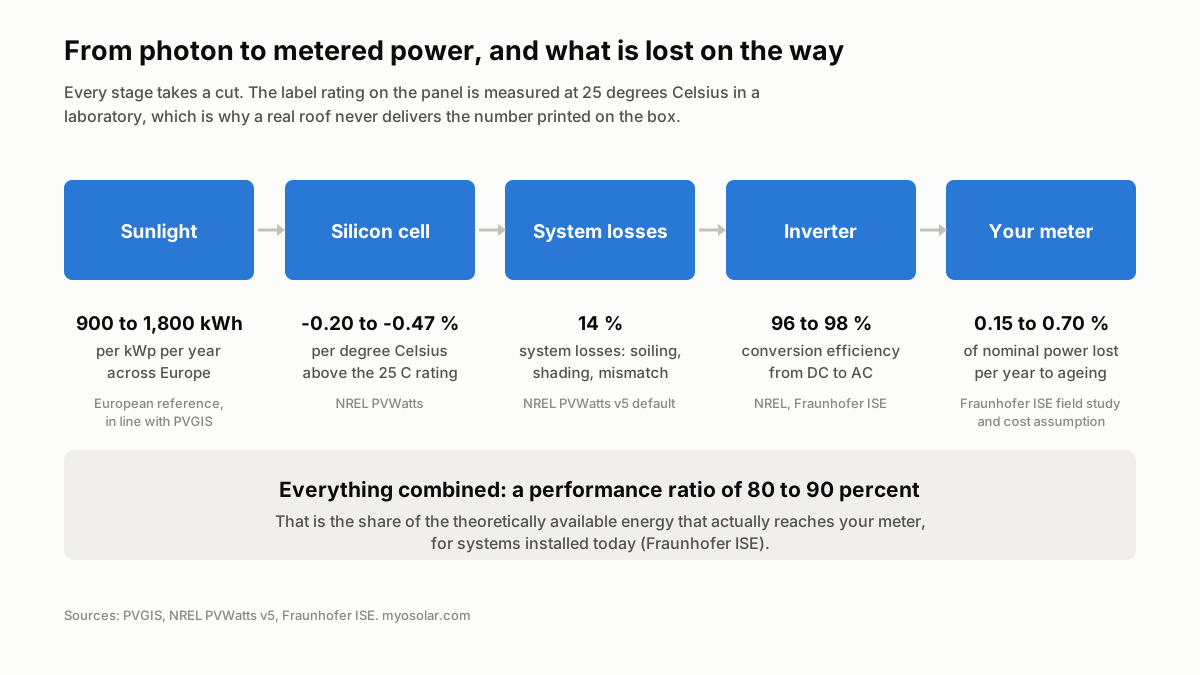
Between the nameplate and your meter stand four physical factors. Across Europe they combine into annual yields from roughly 900 kilowatt hours per kWp in the north to about 1,800 in southern Spain, with about 1,100 a reasonable mid-European reference value. Basis: illustrative European reference values used across myosolar, in line with the European Commission's free PVGIS yield tool, which estimates production for any location.
Irradiance and orientation
Nothing matters more than how much light arrives over the year, which is set by latitude and climate and modified by how the panels face it. In the northern hemisphere a south-facing tilt collects the most annually; east-west layouts collect somewhat less in total but spread production into morning and evening, when households actually consume. Shading is the silent killer: because cells are wired in series, a shadow on part of a string can pull down far more output than its area suggests, which is why a shading analysis belongs in every serious system design.
Temperature
Cell voltage falls as temperature rises. The US Department of Energy describes the mechanism plainly: higher temperatures shift the semiconductor properties, producing a slight increase in current but a much larger decrease in voltage. NREL's PVWatts model puts the temperature coefficient of maximum power at -0.47 percent per degree Celsius for standard crystalline modules, -0.35 for premium crystalline and -0.20 for thin film. A cell running 30 degrees above its rating point therefore gives up roughly 10 to 14 percent of rated power, arithmetic from the coefficients rather than a promise. It also explains a counterintuitive fact: a bright, cold spring day can beat a heatwave afternoon per unit of light.
System losses
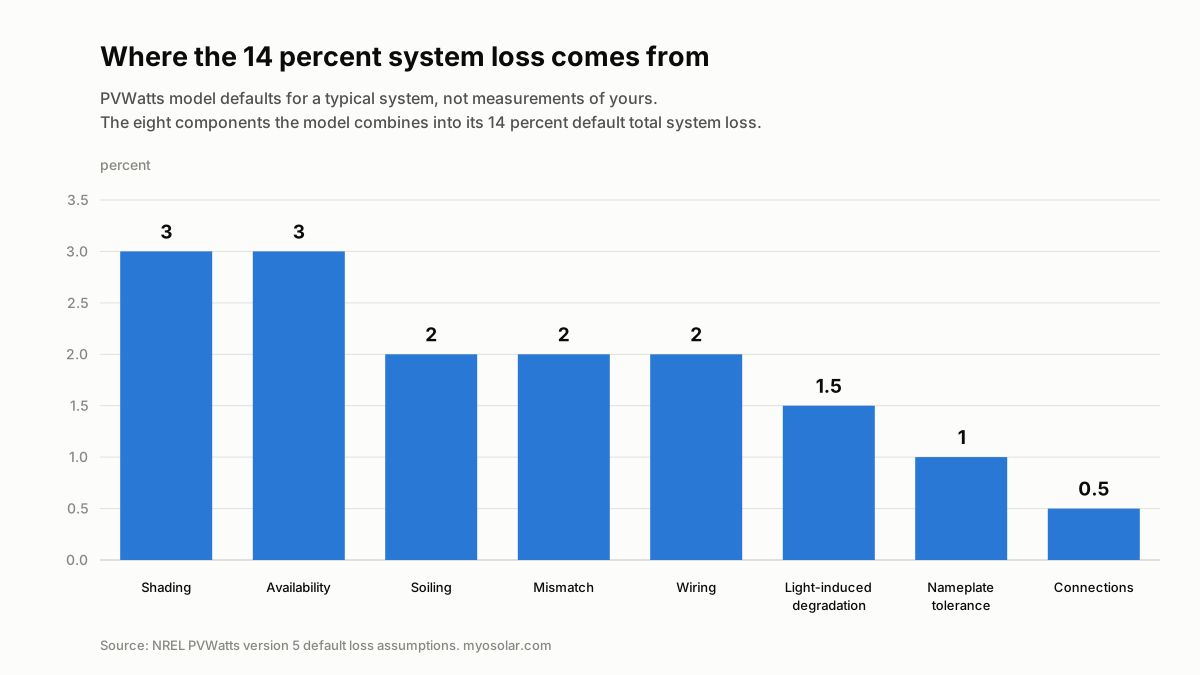
Dust, wiring, mismatch and downtime each shave a little. PVWatts assumes a default total system loss of 14 percent, built from soiling at 2 percent, shading at 3, mismatch at 2, wiring at 2, connections at 0.5, light-induced degradation at 1.5, nameplate tolerance at 1 and availability at 3 percent. Basis: model defaults for a typical system, not measurements of yours. A clean, well-designed and unshaded roof can do better.
Ageing
Modules age slowly. A Fraunhofer ISE field study of 44 larger, quality-tested rooftop systems in Germany measured an average annual degradation of module nominal power of about 0.15 percent, while the institute's cost calculations conservatively assume 0.70 percent per year. Either way, the industry plans around an assumed useful life of roughly 30 years. Basis: the 0.15 percent figure comes from quality-tested German rooftop systems; badly made or badly installed modules can age faster.
| Factor | Typical size | Basis |
|---|---|---|
| Annual irradiance and location | About 900 to 1,800 kWh per kWp per year across Europe | European reference values, in line with PVGIS |
| Cell temperature above the 25 C rating point | -0.20 to -0.47 percent per degree Celsius | NREL PVWatts temperature coefficients |
| System losses (soiling, shading, wiring, mismatch, downtime) | 14 percent model default | NREL PVWatts v5 |
| Inverter conversion | About 96 to 98 percent efficient | NREL default; Fraunhofer ISE on new inverters |
| Ageing | 0.15 to 0.70 percent of nominal power per year | Fraunhofer ISE field study; Fraunhofer ISE cost assumption |
| Everything combined (performance ratio) | 80 to 90 percent | Fraunhofer ISE, systems installed today |
The last row is the honest summary. The performance ratio compares what a system actually delivers with what its modules would produce at nameplate efficiency given the light that really arrived. Systems installed today reach 80 to 90 percent on an annual average, per Fraunhofer ISE. A forecast that quietly assumes more than that is selling you laboratory conditions on a real roof.
Common myths, tested against the mechanism
Do solar panels work on cloudy days?
Yes, at reduced power, and the mechanism says why. Clouds scatter light rather than eliminating it, and diffuse photons free electrons exactly as direct ones do. Output tracks the light reaching the cell, so a heavily overcast sky means a reduced fraction of clear-sky power, not zero. Annual yield depends on total light received over the year, not on the number of postcard-blue days, which is why solar works in cloudy climates too.
Does cold weather stop solar panels?
The opposite. Cold improves the cell's voltage, for the same physical reason heat hurts it, so a cold, clear day is the panel's favourite weather. Winter production is lower across Europe because days are short and the sun sits low, not because cells mind the cold. Snow cover does stop production while it lasts; the same low temperatures mean bright post-snow days convert efficiently.
Do panels wear out after a few years?
Measured degradation of quality-tested rooftop systems averaged about 0.15 percent of nominal power per year in Fraunhofer ISE's field study, and even the conservative 0.70 percent planning assumption leaves a module at more than four fifths of its rated power after 25 years. The component to watch is the inverter, whose power electronics work harder than the glass and silicon above them.
Why this matters when you plan a system
Understanding the chain from photon to AC power turns marketing into arithmetic. A yield forecast is credible when it starts from local irradiance data and applies a performance ratio near the 80 to 90 percent range instead of quietly assuming laboratory conditions. The European Commission's PVGIS tool gives a free, independent estimate for your exact location, and when you collect quotes from local installers, a projection that outruns the physics above is your clearest warning sign.
Frequently asked questions
- How do solar panels produce electricity from sunlight?
- Photons in sunlight transfer energy to electrons in a doped silicon semiconductor, freeing them from their bonds. The electric field at the cell junction pushes the freed electrons through an external circuit as direct current, and an inverter converts that into the alternating current homes and the grid use. It is direct light-to-electricity conversion with no heat step and no moving parts.
- Do solar panels work on cloudy days?
- Yes, at reduced power. Clouds scatter sunlight rather than eliminating it, and diffuse photons free electrons in the cell exactly as direct sunlight does, so output falls roughly in proportion to the light reaching the panel instead of stopping. Annual yield depends on total light received over the year, which is why solar also works in cloudy climates.
- Do solar panels work in winter and cold weather?
- Cold improves a solar cell: voltage rises as temperature falls, the mirror image of the 0.20 to 0.47 percent power loss per degree above 25 degrees Celsius in NREL model values. Winter production is lower because days are short and the sun sits low, not because cells dislike cold. Snow cover pauses production while it lasts.
- How efficient are solar panels?
- The production-weighted average efficiency of crystalline silicon modules was 22.7 percent in the fourth quarter of 2024, and commercial monocrystalline modules reach just under 25 percent, per Fraunhofer ISE. Laboratory records stand at 28.1 percent for silicon cells and 35.2 percent for perovskite-silicon tandem cells. Higher efficiency mainly buys more power per square metre of roof, not more energy per rated kilowatt.
- How long do solar panels last?
- The industry plans around a useful life of roughly 30 years. A Fraunhofer ISE field study of 44 quality-tested German rooftop systems measured average degradation of about 0.15 percent of nominal power per year, while conservative cost calculations assume 0.70 percent. The inverter typically needs replacement earlier than the modules.
- What does kilowatt peak (kWp) mean?
- kWp is the rating measured at standard test conditions: 1,000 watts of light per square metre at a cell temperature of 25 degrees Celsius. Real roofs rarely match those conditions, so kWp works as the unit for comparing systems and prices, while annual kilowatt hours, roughly 900 to 1,800 per kWp per year across Europe, is what pays the bills.
- Why does my solar system produce less than its rated power?
- Because the rating assumes laboratory conditions. Real systems run hotter than 25 degrees Celsius, and soiling, wiring, mismatch and downtime typically remove around 14 percent in standard models, so a well-built system delivers 80 to 90 percent of its theoretical yield on an annual average. A persistent shortfall beyond that usually points to shading or a fault worth investigating.
Sources
- Fraunhofer ISE, Photovoltaics Reportise.fraunhofer.de
- Fraunhofer ISE, Recent Facts about Photovoltaics in Germanyise.fraunhofer.de
- Fraunhofer ISE, Aktuelle Fakten zur Photovoltaik in Deutschlandise.fraunhofer.de
- NREL, PVWatts Version 5 Manualnrel.gov
- US Department of Energy, Solar Performance and Efficiencyenergy.gov
- European Commission JRC, Photovoltaic Geographical Information System (PVGIS)joint-research-centre.ec.europa.eu
We tell you when the rules change
One email when a tariff, a subsidy or a tax rule changes in your country. Nothing else.
France cut its surplus tariff on 5 June 2026, Germany drops its rate by 1 percent on 1 February 2027, Switzerland moves to hourly pricing on 1 January 2027. You would have known.
Written by
myosolar Editorial Team
Editorial Team
The myosolar editorial team researches and updates every article with cited sources.
Matching calculator
Solar savings and payback calculatorRelated guides

Solar systems
How to choose a solar installer: the checks that actually matter
The installer decides more about your yield and your roof than any module datasheet. Here is what to verify, what a complete quote contains, and how long each country holds the installer liable.
Updated 4 August 202610 min read