
Solar systems
How to choose a solar installer: the checks that actually matter
The installer decides more about your yield and your roof than any module datasheet. Here is what to verify, what a complete quote contains, and how long each country holds the installer liable.
How we verify every numberLast verified 4 August 2026
Contents
- Start with the licence, not the price
- What a complete quote contains
- Compare on price per kilowatt, and distrust published ranges
- How long the installer stays liable
- Payment terms tell you more than references
- Never buy at the door
- Questions worth asking out loud
- System size follows your consumption, not your roof area
- Maintenance, monitoring and subcontracting
- Reviews, references and the national versus local question
- Warning signs
- Where to go next
Key takeaways
- Check the installer's licence in the public register of the country the work is in, before you sign. Every market in this guide has one, and all of them are free.
- Quotes are only comparable once every one of them itemises components, labour, meter or consumer unit work, paperwork and the payment schedule.
- Compare on price per kilowatt at identical scope. Published national ranges disagree with each other, so they cannot tell you whether your own quote is fair.
- Statutory defect liability is owed by the contractor and runs between two and ten years depending on country and defect type. A manufacturer guarantee is a different thing and rarely covers labour.
- Never buy at the door. France has banned unsolicited telephone and electronic canvassing for energy renovation outright, and withdrawal rights are a safety net rather than a decision method.
A good solar installer inspects your roof before writing a quote, can prove the licence or qualification their country requires, and itemises every component and every task separately. Everything else is negotiable; those three things are not. The reason is simple: a photovoltaic system is not a product you buy but a building work you commission, and the company that carries it out is the one you will be dealing with for the next two decades.
Start with the licence, not the price
Across Europe, connecting a generator to the grid is regulated work, and the specific credential differs from one country to the next. What does not differ is that the credential is checkable, usually free, usually online, and always before you sign rather than after.
- Austria: the electrical work may only be carried out by a business holding the regulated Elektrotechnik trade licence. Anyone can look up a company in the public GISA register, which gives the name, location and the exact wording of the trade licence.
- Switzerland: an installation permit from the federal inspectorate ESTI is required, and photovoltaic systems are named explicitly among the installations that need the restricted permit for work requiring special knowledge. ESTI publishes the permit registers.
- France: for public support and for the surplus purchase tariff, the use of a qualified company is compulsory, and the panels must be installed by an RGE certified professional. Qualit'EnR and Qualibat both run public directories searchable by company registration number.
- Italy: the company needs the abilitazione under ministerial decree 37/2008 covering electrical systems, and must have filed the corresponding notification with the business register or the register of craft businesses.
- Spain: the company must have filed a declaración responsable with its autonomous community and hold professional liability cover of at least 600,000 euros for the basic category and 900,000 euros for the specialist category, which is the one self-consumption work requires.
What a complete quote contains
Quotes only become comparable once the same line items appear in all of them. Ask every bidder for the same list, in writing, and refuse to compare totals until you have it.
- Every component with manufacturer and model: modules, inverter or micro inverters, mounting system and, where applicable, the battery. Branded modules is not a specification.
- All labour, including scaffolding, cable routes, surge protection, earthing and reinstatement of the roof covering.
- Any consumer unit or meter cabinet work. This is the single most common change order on a residential installation.
- Who files the grid connection paperwork, and who files it with which body.
- The tax rate applied and the rated power used, stated explicitly, because both change how the headline total should be read.
- A payment schedule tied to construction milestones rather than a large deposit on signature.
- The handover pack: circuit diagram, layout plan, datasheets and a commissioning report.
Compare on price per kilowatt, and distrust published ranges
The only figure that makes two quotes comparable is the price per kilowatt of installed capacity, at identical scope. Larger systems are almost always cheaper per kilowatt, because the travel, the scaffolding and the paperwork are spread over more capacity. A small system is therefore not a bad deal simply because its price per kilowatt is higher.
Be careful with published market averages, including ours. In Italy, for example, one energy utility's own guide puts a residential system at 2,500 to 3,500 euros per kilowatt while other market surveys place the range at 1,300 to 2,500 euros per kilowatt. Both figures are honestly reported; they measure different scopes and different periods. The practical consequence is that no published range can tell you whether your quote is expensive. Three quotes for the same specification, from companies in your region, can.
How long the installer stays liable
This is where the difference between a warranty and a guarantee becomes money. Statutory defect liability is owed by the company you contracted with. Manufacturer guarantees on modules and inverters are voluntary, usually longer, and owed by the manufacturer, who will rarely pay for the labour of removing and refitting the part.
| Country | Period | Scope |
|---|---|---|
| Austria | 2 years movable, 3 years immovable | Statutory Gewährleistung against the contractor |
| Germany | 2 or 5 years | Depending on the installation situation, against the contractor |
| Switzerland | 5 years | Claims for defects in an immovable work, from acceptance |
| France | 1 year, 2 years, 10 years | Perfect completion, proper functioning of equipment, and decennial liability |
| Italy | 2 years | Claim against the contractor prescribes 2 years from delivery, with 60 days to report a defect; 10 years for serious defects |
| Spain | 1 year, 3 years, 10 years | Finishing defects, habitability defects, structural defects under the building act |
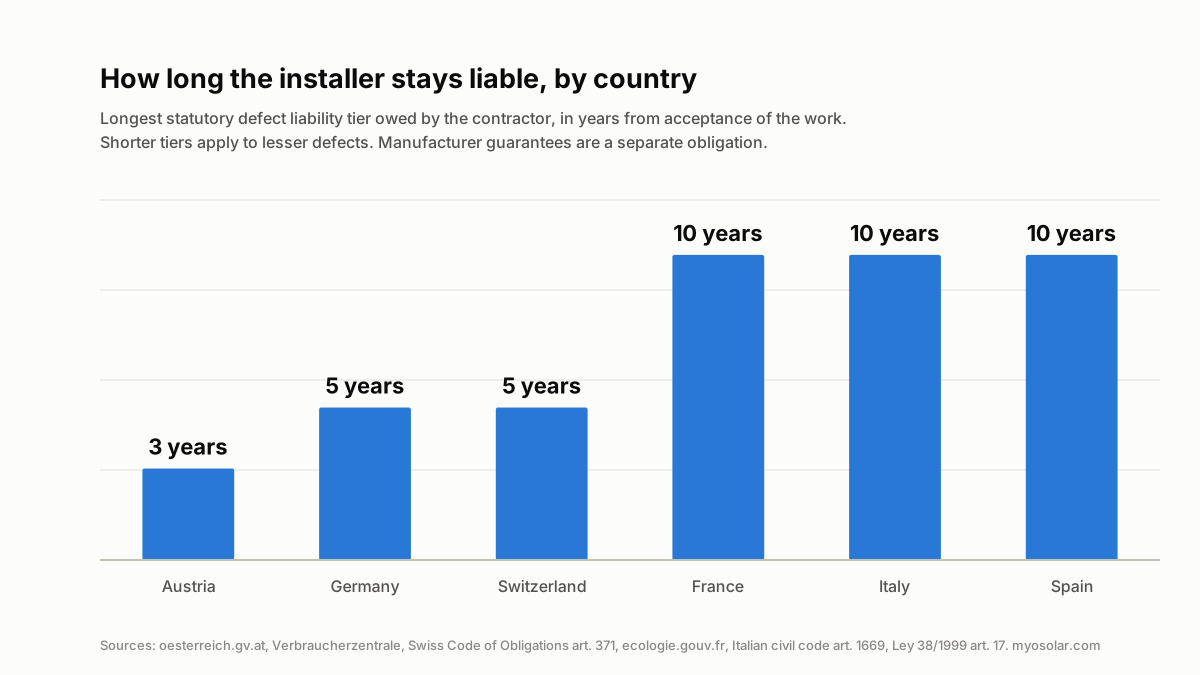
Read the table as a question to put to the installer rather than as reassurance. In every one of these countries the period runs against the contractor, which means it is only worth what the contractor is worth. A company that will still exist in year seven is a materially better bet than one offering a longer paper guarantee today.
Payment terms tell you more than references
A payment schedule is the clearest single signal of how a company is financed. Staged payments against milestones, with a meaningful balance due only after commissioning and handover of documents, mean the company can fund its own work. A large deposit on signature means you are funding it, and it puts you in the weakest possible position if anything goes wrong. Keep a retention until the paperwork is in your hands, not just the panels on your roof.
Never buy at the door
Solar is one of the most heavily canvassed home improvements in Europe, and several countries have legislated against it directly. France has prohibited telephone canvassing in the energy renovation sector since 2020 and extended the ban to electronic canvassing, meaning emails, texts and social media, from 1 July 2025. An unsolicited approach there is itself an offence, which makes it the most reliable quality signal you will ever get.
Withdrawal rights exist as a safety net, and they are useful, but they are not a decision method. In EU member states the withdrawal period for an off premises or distance contract is 14 days, and Italy extends it to 30 days where the contract was concluded during an unsolicited visit to the consumer's home. Switzerland is the outlier: its withdrawal right is narrower, applies to doorstep type situations where the customer's payment exceeds 100 francs, and its application to a contract for a fixed roof installation is not settled.
Questions worth asking out loud
- Which licence or qualification do you hold, and in which register can I look it up?
- Will you visit the roof and open the consumer unit before quoting?
- Which components exactly, by manufacturer and model, and why those?
- Who files the grid paperwork, and by when?
- What is your payment schedule, and what is due only after handover?
- If the inverter fails in year eight, who removes it, who ships it, who refits it, and who pays for that labour?
- Can I speak to two customers whose systems you commissioned in the last year within twenty kilometres of here?
System size follows your consumption, not your roof area
A good installer asks about your annual consumption, your load pattern and whether a heat pump or an EV charger is coming, before saying a word about modules. Sizing from free roof area sells you kilowatts; sizing from consumption sells you self consumption, and self consumption is what pays. Bring your last electricity bill to the site visit and ask which self consumption share the payback calculation assumes and where that assumption comes from. A homeowner who cannot answer that question has not been sold a system, only a price.
Maintenance, monitoring and subcontracting
Installation takes days; operation takes twenty years. Ask what happens after commissioning. Is there monitoring that will tell you a string has failed, or will you discover it on next year's bill? Does the company offer a maintenance agreement, what does it cost, and what does it cover: visual inspection, fixings and torque checks, inverter firmware? How fast do they respond to a fault in November, when yield is low and the pressure to come out is lower still?
Then ask who actually does the work. Subcontracting is normal and not a red flag by itself, but you should know which company will be on your roof, which one holds the electrical credential, and which one your defect claim runs against. That is the company that issues the invoice, whatever the crew's van says. Get it in writing whenever more than one business is involved.
Reviews, references and the national versus local question
An average star rating tells you very little; the pattern inside it tells you a great deal. Read the bad reviews first and look for the same complaint repeating: dates moved, grid paperwork left unfiled, output below forecast, an inverter replacement that took months. One angry customer is normal. The same failure in five reviews is a finding. Then ask for two or three reference installations from the past year within a short drive, and call them: not to hear that it went well, but to hear what went wrong and how the company handled it.
National companies often win on price and financing options; local ones usually win on the thing that decides your next twenty years, which is whether someone answers the phone in year eight. Where statutory liability is short, as in Austria and Germany, that argument is stronger still, because a paper guarantee is only worth the company standing behind it.
Warning signs
- A quote produced without a site visit, or from satellite imagery alone.
- An unsolicited call, message or doorstep visit offering solar.
- A large deposit demanded on signature.
- A twenty year return calculation built on selling electricity to the grid rather than on using it in the building.
- A subsidy or tariff cited without a date or a source you can check.
- Documentation, commissioning reports or compliance certificates presented as paid extras rather than as part of the job.
Where to go next
The checks above hold everywhere; the registers, tax rates, tariffs and deadlines do not. Rules on who may connect a system, what the grid operator requires and which subsidies are open change by country and sometimes by month, so use the myosolar edition for the country the roof is in, and take three quotes from installers in your own region before you compare anything at all.
Frequently asked questions
- How do I check that a solar installer is properly licensed?
- Use the public register in the country where the work will be done. Austria publishes trade licences in GISA, Switzerland publishes installation permits through ESTI, France lists RGE certified companies in the Qualit'EnR and Qualibat directories, Italy records the decree 37/2008 abilitazione in the business register, and Spain publishes installer companies through the national industrial register and regional search tools.
- What should a solar quote include?
- Every component with manufacturer and model, all labour including scaffolding and roof reinstatement, any meter or consumer unit work, the tax rate and rated power used, who files the grid paperwork, a payment schedule tied to milestones, and the handover documentation. A quote that fits on one page is not cheaper, it is incomplete.
- Is a longer manufacturer guarantee better than a shorter one?
- Not necessarily, because it is a different obligation. Statutory defect liability is owed by the company that installed the system and typically runs between two and ten years depending on the country and the type of defect. A manufacturer guarantee is owed by the manufacturer, usually excludes the labour of removing and refitting the part, and is worth nothing if no local company will handle the claim.
- Why is price per kilowatt the right comparison?
- Because it removes system size from the comparison. Fixed costs such as travel, scaffolding and paperwork are spread over more capacity on a larger system, so larger systems almost always show a lower price per kilowatt. Comparing totals across different sizes tells you nothing; comparing price per kilowatt at identical scope tells you a great deal.
- Does a solar system need maintenance?
- Technically it is close to maintenance free, but it does not run well unattended. What matters is monitoring that flags a failed string or inverter, and periodic checks of fixings and connections. Whether you need a paid maintenance agreement depends on the company; ask for its scope and price in writing before you sign, and ask how fast they respond to a fault in winter.
- Is a national solar company better than a local one?
- They tend to win on different things. National companies often offer better pricing and more financing options; local companies are usually better at the part that decides the next twenty years, which is showing up in year eight. Statutory defect liability runs against the company you contracted with, so in markets with shorter liability periods the installer's own longevity matters more, not less.
- How do I read solar installer reviews properly?
- Not by the average score. Read the negative reviews first and look for a repeating complaint: rescheduled dates, unfiled grid paperwork, output below forecast, slow warranty handling. One bad review is noise; the same failure five times is a finding. Then call two or three recent local reference customers and ask specifically what went wrong and how the company responded.
Sources
- E-Control Austria, grid connection action plan: electrical work on a PV system only by holders of the regulated Elektrotechnik trade licencee-control.at
- USP.gv.at, GISA extracts and enquiries: name, location and wording of the trade licence are publicly availableusp.gv.at
- ESTI Switzerland, permits for installation work on special installations under article 14 NIV: photovoltaic systems named explicitlyesti.admin.ch
- ESTI Switzerland, public permit registersesti.admin.ch
- French Ministry of the Economy: use of a qualified company is compulsory and panels must be installed by an RGE certified professionaleconomie.gouv.fr
- Qualit'EnR, public directory of RGE certified companies searchable by SIRETqualit-enr.org
- Chamber of Commerce of Rome, installation of systems: notification to the business register or the register of craft businesses, and the conformity declarationrm.camcom.it
- Spain, RD 560/2010: declaración responsable before the autonomous community and professional liability cover of 600,000 and 900,000 eurosboe.es
- Spanish Ministry of Industry, Guía-BT-03: low voltage generating installations for self consumption require the specialist categoryindustria.gob.es
- oesterreich.gv.at, Gewährleistung: two years for movable and three years for immovable thingsoesterreich.gv.at
- Verbraucherzentrale Germany, guarantee and insurance conditions: statutory liability of two or five yearsverbraucherzentrale.de
- Swiss Code of Obligations article 371: claims for defects in an immovable work prescribe five years after acceptanceswissrights.ch
- French Ministry of Ecological Transition: one year perfect completion, two year proper functioning and ten year decennial liabilityecologie.gouv.fr
- Italian civil code article 1667: sixty days to report defects, action prescribes two years from delivery of the workbrocardi.it
- Italian civil code article 1669: contractor liable for serious defects appearing within ten years of completionbrocardi.it
- Spain, Ley 38/1999 building act article 17: liability periods of one, three and ten yearsboe.es
- Service-public entreprendre France: telephone and electronic canvassing in energy renovation prohibited from 1 July 2025entreprendre.service-public.gouv.fr
- MIMIT Italy, right of withdrawal: 14 days, extended to 30 days for contracts concluded during unsolicited visits to the consumer's homemimit.gov.it
- ch.ch Switzerland, returning goods: 14 days for doorstep type contracts where the value exceeds 100 francsch.ch
- Sorgenia, cost of a photovoltaic system in Italy: 2,500 to 3,500 euros per kWpsorgenia.it
- Fotovoltaico Casa, cost of a photovoltaic system in Italy: 1,300 to 2,500 euros per kWpfotovoltaico-casa.it
We tell you when the rules change
One email when a tariff, a subsidy or a tax rule changes in your country. Nothing else.
France cut its surplus tariff on 5 June 2026, Germany drops its rate by 1 percent on 1 February 2027, Switzerland moves to hourly pricing on 1 January 2027. You would have known.
Written by
myosolar Editorial Team
Editorial Team
The myosolar editorial team researches and updates every article with cited sources.
Matching calculator
Solar savings and payback calculatorRelated guides
Solar systems
How solar panels work: from photon to AC power
The photovoltaic effect explained without hand-waving: what happens inside a silicon cell, how cells become a system, and what actually determines the energy your roof delivers.
Updated 4 August 20269 min read