
Prices and incentives
How to compare solar quotes without being fooled
Quotes for the same roof can differ by thousands and still both be fair. Reduce every offer to a price per kilowatt installed, check what that price includes, and know the red flags that end a conversation.
How we verify every numberLast verified 3 August 2026

Key takeaways
- Divide every all-in price by its kWp: price per kilowatt installed is the only number that makes solar offers comparable.
- As a European reference, rooftop systems cost 900 to 1,500 euros per kWp at the end of 2025; smaller systems sit higher.
- On the spec sheet, temperature coefficient, warranty structure and the forecast method matter; Tier 1 labels and half-point efficiency gaps are noise.
- A production forecast implying a performance ratio above 80 to 90 percent is a promise the sun will not keep.
- Time-pressure discounts, unnamed components and single-line prices are exit signals, not negotiation openers.
Solar quotes become comparable the moment you divide each all-in price by the system's rated kilowatts: cost per kW installed is the one number that puts a 4.8 kWp offer and a 6.3 kWp offer on the same scale. Everything else in this guide exists to make that division honest: to check the price is complete, the components are named, and the production forecast obeys physics.
The structure below works in any country, because it rests on what a quote physically is: a scope of work, a bill of components, a forecast and a set of promises. National taxes, grid paperwork and subsidy lines differ, so where they appear, check your national rules.
What a complete quote contains, anywhere
Layouts differ; the substance of a complete quote does not. Before comparing any prices, check that each offer specifies:
- System size in kWp and the exact module count, with the module named precisely enough to find its datasheet.
- The inverter, named and sized, and whether per-module optimisers or module-level electronics are included, with a reason.
- The mounting system and the roof attachment method for your specific roof type.
- All electrical work: DC and AC cabling, protection devices, earthing, and any meter or distribution board changes.
- Scaffolding or roof access, stated as a line, not assumed away.
- Grid connection and registration paperwork: who files what, and whether it is in the price.
- Commissioning, documentation and handover, including monitoring set-up.
- A production estimate for your actual orientation, tilt and shading, with the method named.
- Warranty terms: workmanship, product and performance, and who honours each in practice.
- The total price with tax treatment stated, the payment schedule and the validity period.
A quote missing several of these is not cheaper; it is unfinished. The consequence: every unstated item returns later as an extra, priced without competition.
Compare on price per kilowatt installed
Divide each all-in price by the kWp. As a European reference, Fraunhofer ISE puts a 10 kWp rooftop system at 900 to 1,500 euros per kWp at the end of 2025. Basis: German market prices used as a European reference; myosolar widens the range to about 1,800 euros per kWp for higher-cost markets, and smaller systems sit above these figures because scaffolding, paperwork and the crew's day do not shrink with size.
System size
- A6.0 kWp
- B5.1 kWp
- C7.2 kWp
Show the numbersHide the numbers
| Offer | System size | All-in price | Price per kWp |
|---|---|---|---|
| A | 6.0 kWp | 8,900 EUR | 1,483 EUR |
| B | 5.1 kWp | 8,200 EUR | 1,608 EUR |
| C | 7.2 kWp | 9,360 EUR | 1,300 EUR |
Offer B has the lowest sticker price and the highest real price. Offer C sells the cheapest kilowatts, but only the completeness checklist tells you whether its price contains the same work. Basis: illustrative figures chosen inside the European reference range; the arithmetic, not the example, is the point.
The division only works after three normalisations. First, tax treatment: residential PV carries reduced or zero VAT in some countries and full rates in others, so confirm every offer states the same basis and check your national rules. Second, scope: a price without scaffolding is not comparable to one with it. Third, storage: if one offer bundles a battery, ask for it as a separate line, because battery economics deserve their own calculation and a bundle hides both prices. Only then does price per kWp mean what it appears to mean.
Spec sheet items that matter, and the noise
Datasheets exist to be compared, but only a few lines on them change what your roof earns. Modern modules are tightly clustered products built in enormous volumes, so the technical spread between serious offers is narrower than the brochures suggest. Spend your attention where the physics says the money is.
Worth your attention
- Module power and efficiency, in context: the production-weighted average efficiency of crystalline silicon modules was 22.7 percent in late 2024, and the best commercial monocrystalline modules reach just under 25 percent, per Fraunhofer ISE. Figures far below the average suggest dated stock; figures above the commercial ceiling suggest someone is quoting laboratory values.
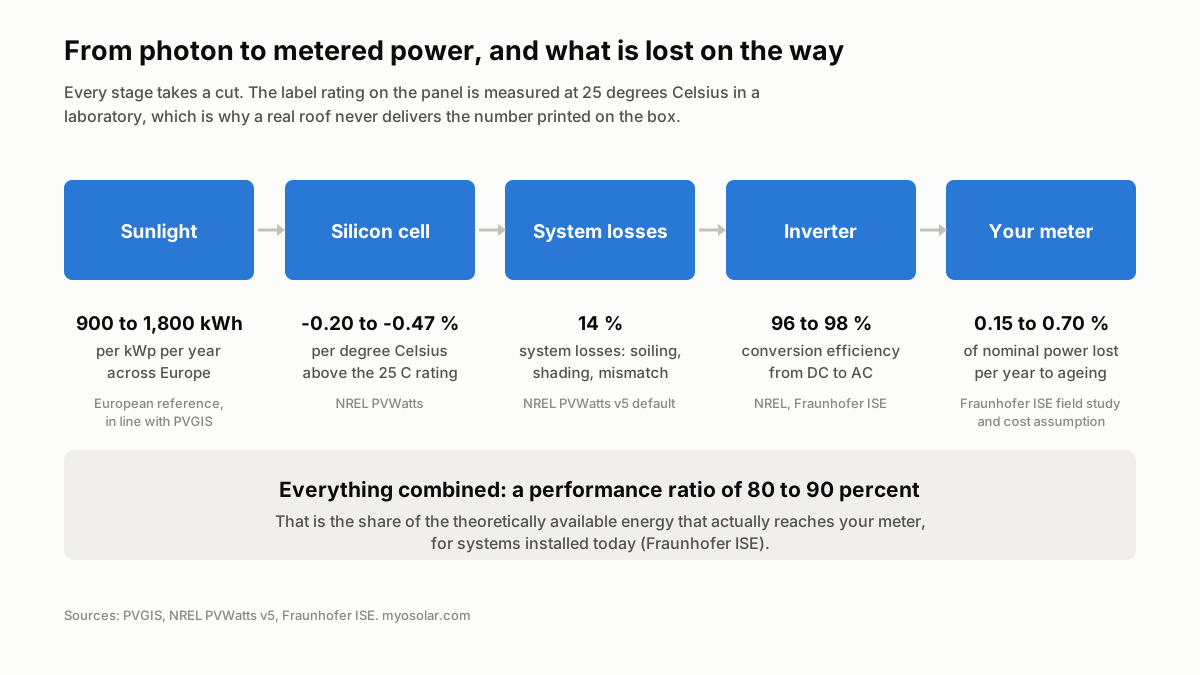
- Temperature coefficient of power: standard crystalline modules lose 0.47 percent of output per degree Celsius above the 25 degree rating point in NREL's reference model, premium ones 0.35. On a roof that runs hot every summer, the difference is real energy.
- Warranty structure: the years on the product warranty, the curve on the performance warranty, and who honours each if the installer disappears. Read the numbers, not the adjectives.
- Inverter efficiency and sizing: new inverters convert at around 98 percent per Fraunhofer ISE. Ask how the inverter's rated power relates to the array size and why that ratio was chosen for your roof.
- The forecast method: a serious production estimate starts from local irradiance data and applies losses; well-built systems achieve performance ratios of 80 to 90 percent per Fraunhofer ISE. Ask which performance ratio your forecast assumes.
Mostly noise
- Premium and Tier 1 labels: Tier 1 describes a manufacturer's standing with banks financing large projects, not the quality of the module on your roof.
- Half-point efficiency differences between two modern modules: at equal system kWp, the less efficient module simply occupies slightly more roof area. If your roof has the room, the money argument evaporates.
- Small differences in nameplate watts per module: system kWp and price per kWp already contain this information.
- Free extras: monitoring apps, bird protection and cleaning vouchers priced as gifts are in the price somewhere. Value the system, not the gift.
The noise is not accidental. When products converge, sales language diverges: average commercial module efficiency moved from 21.6 to 22.7 percent in a single year per Fraunhofer ISE, which means competing modules often differ less between brands than one production year does within them. A seller who cannot win on scope or price will try to win on adjectives, and the defence is simply to price the system, not the story.
Red flags that should end the conversation
- A price valid only today. Serious offers survive a week of thinking; expiring discounts are a pressure tactic, not a price.
- No roof inspection or shading assessment before a binding price: the quote is a template, and the surprises will be yours.
- One line saying complete solar system with a total: nothing to compare, nothing to hold anyone to.
- Production promises above the physics: a forecast implying a performance ratio above the 80 to 90 percent range, or yields far beyond your region's reference values, is a promise the sun will not keep.
- Payment terms that front-load most of the money before installation.
- Unnamed components: a quality module from a leading manufacturer is not a specification, and you cannot check a datasheet that does not exist.
- Savings projections built on electricity prices far above your bill, or on self-consumption near 100 percent, when households typically use 20 to 40 percent of their solar production directly, per Fraunhofer ISE.
A comparison that takes one evening
- Check completeness first: run every offer against the checklist above and note what is missing. An incomplete quote either gets completed or gets dropped.
- Normalise and divide: same tax basis, same scope, battery separated, then compute the all-in price per kWp for each offer.
- Sanity-check the forecasts: compare each production estimate against an independent PVGIS estimate for your roof, and discard any offer whose numbers cannot survive the comparison.
- Compare warranty structures on years and coverage, weighting manufacturer-backed terms above installer promises.
- Only now look at the prices together: the cheapest complete, physically honest offer per kilowatt is your benchmark, and everything above it must justify the difference in scope or quality.
Questions to ask every installer
- What exactly is included in this price, and what are the three most common extras on projects like mine?
- What is the all-in price per kWp of this offer, and how does it change if the system is one size larger or smaller?
- How was my production estimate calculated, and what performance ratio does it assume?
- Who performs the electrical work, who files the grid registration, and who is liable for each?
- Which warranties are honoured directly by the component manufacturers if your company is gone in year twelve?
- What did the shading analysis of my roof find, and how does the design respond to it?
- What share of the payment is due before the system is commissioned and working?
- If I add a battery later, what does this design make easy, and what does it make expensive?
Collect two or three quotes from local installers, force them onto the same per-kilowatt scale, and let the checklist negotiate for you. A good installer answers these questions easily; some visibly enjoy being asked. The consequence: the questions cost you nothing, and every answer is either reassurance or a mistake you did not pay for.
Frequently asked questions
- How many solar quotes should I get?
- Two or three from local firms is enough to see the market, provided you make them comparable: same scope, all-in prices, divided by kWp. A single quote anchors your expectations to one company's pricing. More than four rarely changes the decision and costs weeks.
- What is a fair price per kW for a solar system in Europe?
- As a European reference, Fraunhofer ISE puts a 10 kWp rooftop system at 900 to 1,500 euros per kWp at the end of 2025, and higher-cost markets run to about 1,800. Smaller systems cost more per kilowatt because fixed costs do not shrink. National labour costs and tax treatment shift the level, so check your national rules and compare offers within your own market.
- Why do solar quotes differ so much for the same house?
- Three honest reasons: scope (scaffolding, meter work, paperwork included or not), component class, and system size, since larger systems are cheaper per kilowatt. The dishonest reason is margin hidden behind vague line items. Reducing every offer to an all-in price per kWp with a stated scope exposes which reason you are looking at.
- What should a solar quote include?
- Named modules and inverter with datasheets, system size in kWp, mounting and roof work, all electrical work, scaffolding, grid registration, commissioning and documentation, a production estimate with its method, warranty terms, and an all-in price with payment schedule. Anything less is an estimate, not a quote.
- How do I check a solar production estimate?
- Get an independent reference from the European Commission's free PVGIS tool for your exact location and orientation, then compare. A serious forecast applies a performance ratio in the 80 to 90 percent range that well-built systems achieve. If the installer's number is far above your PVGIS estimate, ask for the method before you sign anything.
- Is the cheapest solar quote the best?
- The cheapest complete quote often is; the cheapest sticker price often is not. A low total can mean a smaller system, missing scope or unnamed components. Compare price per kWp across offers with identical scope, then let completeness and warranty structure break the tie.
Sources
- Fraunhofer ISE, Photovoltaics Reportise.fraunhofer.de
- Fraunhofer ISE, Recent Facts about Photovoltaics in Germanyise.fraunhofer.de
- Fraunhofer ISE, Aktuelle Fakten zur Photovoltaik in Deutschlandise.fraunhofer.de
- NREL, PVWatts Version 5 Manualnrel.gov
- European Commission JRC, PVGISjoint-research-centre.ec.europa.eu
We tell you when the rules change
One email when a tariff, a subsidy or a tax rule changes in your country. Nothing else.
France cut its surplus tariff on 5 June 2026, Germany drops its rate by 1 percent on 1 February 2027, Switzerland moves to hourly pricing on 1 January 2027. You would have known.
Written by
myosolar Editorial Team
Editorial Team
The myosolar editorial team researches and updates every article with cited sources.
Matching calculator
Solar savings and payback calculatorRelated guides
Prices and incentives
Is solar worth it? Four numbers decide, wherever you live
No universal yes exists. Whether rooftop solar pays depends on four numbers you can find for your own house; here is the framework, a worked European example, and the honest list of cases where it does not pay.
Updated 3 August 20268 min read
Prices and incentives
Solar panel cost in 2026: what a system really costs
Current prices per kWp, worked examples for 5, 10 and 15 kWp and an honest payback calculation. Every figure carries its source.
Updated 3 August 20266 min read
Solar systems
How solar panels work: from photon to AC power
The photovoltaic effect explained without hand-waving: what happens inside a silicon cell, how cells become a system, and what actually determines the energy your roof delivers.
Updated 4 August 20269 min read