
Prices and incentives
Is solar worth it? Four numbers decide, wherever you live
No universal yes exists. Whether rooftop solar pays depends on four numbers you can find for your own house; here is the framework, a worked European example, and the honest list of cases where it does not pay.
How we verify every numberLast verified 3 August 2026
Key takeaways
- Four numbers decide solar anywhere: system cost per kW installed, your electricity price, your self-consumption share and the export rate. There is no universal yes or no.
- At European reference values, a 5 kWp system at 1,200 EUR per kWp pays back in about 7.6 years without any subsidy.
- The same reference system pays back in about 6.4 years under German tariffs, 6.3 under Italian and 13.8 under the current French surplus regime: geography is the deciding variable.
- A self-consumed kilowatt hour is worth several times an exported one in most of Europe, so daytime consumption habits move the result more than equipment choices.
- Solar does not pay on heavily shaded roofs, at very low electricity prices with weak export pay, or on roofs that need renovation first.
Whether rooftop solar is worth it is not a matter of opinion, and not a matter of country: it is decided by four numbers, and you can find every one of them for your own house. They are the cost per kilowatt of installed system, the price you pay per kilowatt hour of electricity, the share of solar production you consume yourself, and what you are paid for the surplus you export.
This guide shows how the four combine, works a fully labelled European reference example, and, just as importantly, lists the situations in which solar does not pay. Subsidies, tax rates and export schemes differ by country and change often, so they appear here as local details to check, never as universal facts.
The four numbers that decide it anywhere
- System cost per kilowatt installed: the all-in price of the installed system divided by its rated kWp.
- Your electricity price: the per kilowatt hour rate on your bill, because that is what each self-consumed solar kWh saves you.
- Self-consumption share: the fraction of solar production your household uses at the moment it is produced.
- Export remuneration: what your grid or buyer pays for each kWh you feed in.
1. System cost per kilowatt installed
Fraunhofer ISE puts the price of a 10 kWp rooftop system at 900 to 1,500 euros per kWp at the end of 2025. Basis: German market prices, the largest European market, used here as a European reference; myosolar widens the reference range to about 1,800 euros per kWp to cover higher-cost markets. Smaller systems cost more per kilowatt because scaffolding, paperwork and the crew's day do not shrink with system size. The consequence: the headline total of a quote means little until you divide it by the kWp.
2. Your electricity price
Every solar kilowatt hour you consume yourself is one you do not buy. The EU average household electricity price was 0.2896 euros per kWh in the second half of 2025, weighted by national consumption, per Eurostat. The spread is enormous: from 0.4042 euros in Ireland and 0.3869 in Germany down to 0.1082 in Hungary. The consequence: the identical roof earns nearly four times more per self-consumed kWh in Dublin than in Budapest, which is why no honest answer to this question ignores geography.
3. Self-consumption share
Households achieve 20 to 40 percent self-consumption of the electricity their systems generate, depending on system size, per Fraunhofer ISE. Basis: measured German household systems; the pattern travels because it follows from behaviour rather than tariffs: production peaks at midday, consumption in the morning and evening. Working from home, a midday-charging electric car, a heat pump, or simply timing the dishwasher raise the share; an empty house all day lowers it. Under the reference values in this article a self-consumed kWh is worth about 3.6 times an exported one, so this behavioural number moves the result more than any spec sheet.
4. Export remuneration
What the surplus earns is a national policy decision, and it varies by an order of magnitude across Europe. In Germany, systems up to 10 kWp commissioned between August 2026 and January 2027 receive a statutory 7.70 cents per kWh for surplus feed-in. In France, applications filed since 5 June 2026 receive 1.1 cents. In Italy, the dedicated withdrawal scheme paid an average zonal price of about 12.8 cents in the first quarter of 2026, with a guaranteed minimum of 4.75 cents. Check your national rules before computing anything. The consequence: with a 1 cent export rate, oversizing a system to export more is close to pointless; at 12 cents it can be rational.
| Number | European reference value | Where to find yours |
|---|---|---|
| System cost per kWp | 900 to 1,500 EUR per kWp for a 10 kWp rooftop system, end of 2025 (Fraunhofer ISE) | Divide each all-in quote by its kWp |
| Electricity price | 0.2896 EUR per kWh, EU household average, second half of 2025 (Eurostat) | The per-kWh rate on your bill, not the bill total divided by usage |
| Self-consumption share | 20 to 40 percent of generation for households (Fraunhofer ISE) | Daytime habits now, meter data after installation |
| Export remuneration | Roughly 1 to 13 cents per kWh depending on country (national regulators) | Your national scheme; check the current rules |
A worked example, with every assumption labelled
Take a 5 kWp system in a mid-European location. Every value below is a labelled European reference, not a quote from any specific market.
- System cost: 5 kWp at 1,200 EUR per kWp, total 6,000 EUR, inside the Fraunhofer ISE range.
- Yield: 1,100 kWh per kWp per year, a mid-European reference value; European locations range from about 900 to 1,800. Production: 5,500 kWh per year.
- Self-consumption: 30 percent, the middle of the documented household range. 1,650 kWh used at home, 3,850 kWh exported.
- Prices: 0.29 EUR per kWh for grid electricity, close to the EU average, and 0.08 EUR per kWh export remuneration as an illustrative European reference.
Self-consumed value: 1,650 kWh at 0.29 EUR is 479 EUR per year. Export value: 3,850 kWh at 0.08 EUR is 308 EUR. Total: about 787 EUR per year, for a simple payback of 6,000 divided by 787, about 7.6 years. Set against an assumed useful life of roughly 30 years per Fraunhofer ISE, that leaves a long surplus period even after one inverter replacement and module ageing of 0.15 to 0.70 percent per year. The consequence: move any of the four numbers and the result moves with it, which is exactly why you compute your own case rather than borrowing someone else's.
Annual value
- European reference787 EUR
- Germany935 EUR
- Italy954 EUR
- France435 EUR
Show the numbersHide the numbers
| Scenario | Electricity price | Export rate | Annual value | Simple payback |
|---|---|---|---|---|
| European reference | 0.29 EUR/kWh | 8.0 cents (illustrative) | 787 EUR | 7.6 years |
| Germany | 0.3869 EUR/kWh (Eurostat, H2 2025) | 7.7 cents (statutory surplus tariff) | 935 EUR | 6.4 years |
| Italy | 0.2797 EUR/kWh (ARERA reference customer) | 12.8 cents (average zonal price, Q1 2026) | 954 EUR | 6.3 years |
| France | 0.238 EUR/kWh (derived from the regulated tariff) | 1.1 cents (surplus tariff since June 2026) | 435 EUR | 13.8 years |
Same roof, same cost, and paybacks from about 6 to 14 years purely from national prices and export rules. Basis: the identical 6,000 EUR reference system with national electricity prices and export rates as cited; real projects also differ in system cost and yield between these countries, so this table isolates the tariff effect only.
When solar does not pay
- Heavy shading: series-wired panels lose disproportionately, and a roof shaded through the core of the day may never approach the reference yields.
- Cheap electricity plus negligible export pay: run the reference system at 0.11 EUR per kWh with a 3 cent illustrative export rate and the annual value drops to about 297 EUR, a payback of roughly 20 years.
- A roof due for renovation: dismantling and remounting a system costs real money, so renovate first, then install.
- Very small systems: below a few kWp the fixed costs dominate and the price per kilowatt climbs out of the reference range.
- An empty house in daylight combined with a near-zero export rate: self-consumption falls toward the bottom of the range exactly where the surplus earns least.
- Expensive financing: interest competes directly with the annual value, and a loan rate above the system's effective return erases the case.
None of these are failures of the technology. They are cases where the four numbers land badly, and the framework exists so you find that out before spending money, not after.
How to compute your own case
- Get a local yield estimate. The European Commission's free PVGIS tool estimates production for any location; note the kWh per kWp per year.
- Read your bill. Use the full per-kWh price including taxes, and ignore fixed standing charges, because solar does not reduce them.
- Estimate self-consumption honestly. 20 to 40 percent is the documented household range without a battery; place yourself by daytime occupancy and flexible loads.
- Find your export rule from a regulator or official source, not a sales brochure, and check your national rules on taxes and registration while you are there.
- Collect two or three quotes from local installers and divide each all-in price by its kWp, so you compare cost per kilowatt rather than sticker totals.
- Compute annual value and payback with the formula above, then stress it: lower the electricity price, cut the export rate. A yes that survives the stress test is a real yes.
One honest limit: the largest unknown in any solar calculation is your future electricity price, and nobody can verify a forecast of it. The framework above deliberately uses today's prices. If yours rise, the case improves; if they fall, the payback stretches. Buying solar is, among other things, a fixed-price contract for part of your future electricity, and that is a position on prices, not a certainty.
Frequently asked questions
- Is solar worth it in 2026?
- For most unshaded European roofs the arithmetic still works: at European reference values a mid-sized system pays back in about 7.6 years against a useful life of roughly 30. But the answer is decided by four local numbers, not by the calendar year, so compute system cost per kW, your electricity price, your self-consumption share and your export rate before believing anyone's yes.
- How long does it take for solar panels to pay for themselves?
- At European reference values, about 7.6 years for a 5 kWp system costing 6,000 EUR. Under current national tariffs the same system lands at roughly 6.4 years in Germany, 6.3 in Italy and 13.8 in France, because export remuneration differs sharply between countries. Your own cost per kW, electricity price and self-consumption shift the result further.
- Is solar worth it without subsidies?
- Often yes. The worked example in this article contains no subsidy at all and reaches payback in about 7.6 years at European reference values. Subsidies and tax reliefs shorten paybacks where they exist, so check your national rules, but a sound case should not depend on them.
- Is solar worth it if nobody is home during the day?
- It weakens the case, especially where export pay is low: an empty house pushes self-consumption toward 20 percent, the bottom of the documented range. Timers on the dishwasher and washing machine, a midday-charging electric vehicle or a battery raise the share. Run the numbers with an honest self-consumption estimate before deciding.
- Is solar worth it in northern Europe?
- Yields in northern Europe sit near the 900 kWh per kWp end of the European range, against about 1,800 in southern Spain, but payback depends on electricity prices too, and some of Europe's highest household prices are in the north and west, such as 0.4042 EUR per kWh in Ireland per Eurostat. A high-price, moderate-sun country can beat a low-price, sunny one.
- Does a home battery make solar more worth it?
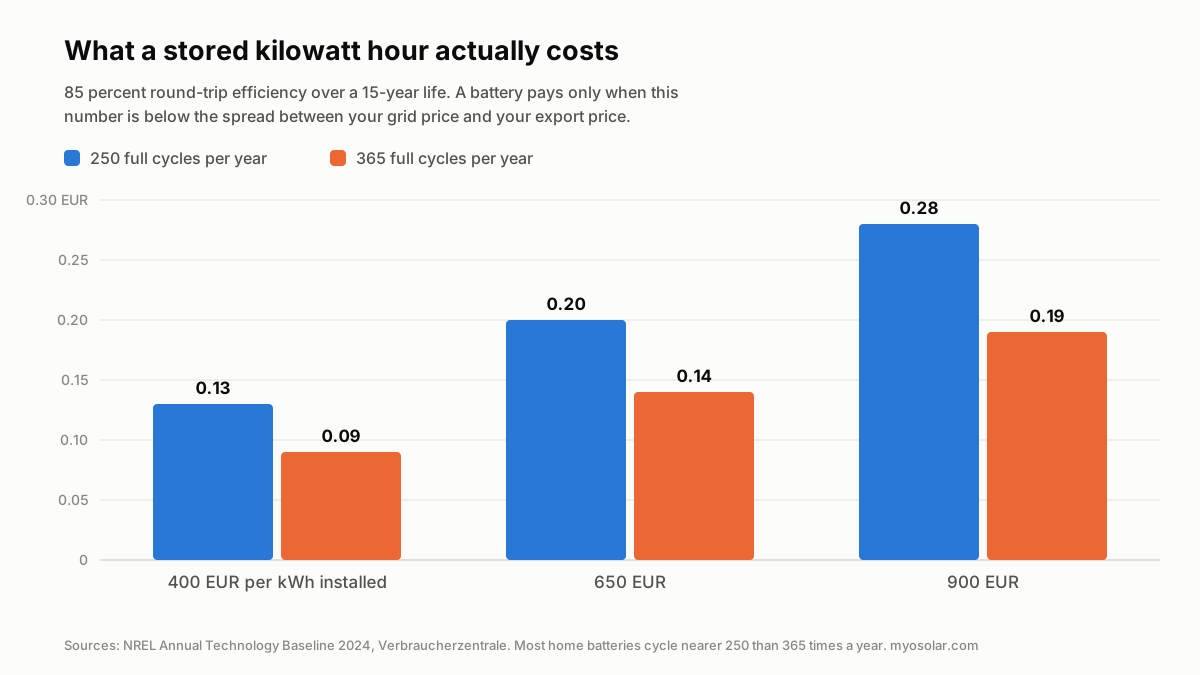
- A battery raises self-consumption, but it adds its own cost per stored kilowatt hour, so it is a separate calculation rather than an automatic upgrade. It pays when storing a kilowatt hour costs less than the spread between your electricity price and your export rate. Do the solar arithmetic first, then the battery arithmetic on top.
Sources
- Fraunhofer ISE, Photovoltaics Reportise.fraunhofer.de
- Eurostat, Electricity price statisticsec.europa.eu
- Fraunhofer ISE, Aktuelle Fakten zur Photovoltaik in Deutschlandise.fraunhofer.de
- Bundesnetzagentur, EEG feed-in remunerationbundesnetzagentur.de
- CRE, deliberation 2026-92 on the S21 tariff decreecre.fr
- GSE, Ritiro Dedicato economic regulationgse.it
- European Commission JRC, PVGISjoint-research-centre.ec.europa.eu
We tell you when the rules change
One email when a tariff, a subsidy or a tax rule changes in your country. Nothing else.
France cut its surplus tariff on 5 June 2026, Germany drops its rate by 1 percent on 1 February 2027, Switzerland moves to hourly pricing on 1 January 2027. You would have known.
Written by
myosolar Editorial Team
Editorial Team
The myosolar editorial team researches and updates every article with cited sources.
Matching calculator
Solar savings and payback calculatorRelated guides
Prices and incentives
Solar panel cost in 2026: what a system really costs
Current prices per kWp, worked examples for 5, 10 and 15 kWp and an honest payback calculation. Every figure carries its source.
Updated 3 August 20266 min read
Battery storage
Home battery guide: the arithmetic that decides
A home battery earns the spread between your electricity price and your export rate, and it costs a fixed amount per stored kilowatt hour. Whether it is worth it is one honest comparison, worked here with European reference values.
Updated 4 August 20268 min read

Prices and incentives
How to compare solar quotes without being fooled
Quotes for the same roof can differ by thousands and still both be fair. Reduce every offer to a price per kilowatt installed, check what that price includes, and know the red flags that end a conversation.
Updated 3 August 20268 min read